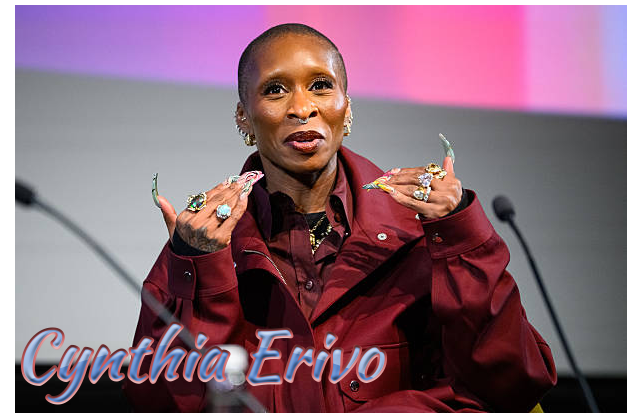
(ThySistas.com) A couple of weeks back, while the rest of us sorted fall budgets and argued over whose turn it was to host Sunday dinner, Cynthia Erivo sat front row in Paris and made the whole circus pause. Dior one afternoon. Chloé the next. Valentino after that. Somebody over at TheWrap joked that if there were a trophy for front row stamina, the woman would carry it home. Stamina was not the thing that caught me, though. What grabbed hold was how completely she showed up as nobody but herself.
You already know the look. A bald head, polished and worn like a crown. Nails long enough to make a point, and filed sharp enough to make a second one. Heels that practically dare a stranger to comment. Over at Chloé, she embraced a bold mix of colors and textures, and the whole thing held because she had decided it would.
Now, let me explain why a grown Sista down South pays any mind to what got worn on a runway an ocean away.
For the longest time the business handed us one script. Smile smaller. Soften the voice. Press the hair, cover the hair, apologize for the hair. Shrink the laugh so a room stays comfortable. Plenty of Black women knew that script cold by middle school. Some of us are still trying to shake it loose decades later. That struggle runs quieter and lasts longer than anybody warns you. So here comes a dark-skinned woman into one of the snobbiest rooms Paris has going, bald head, no apology, standing like the floor was built for exactly this. The moment stops being about clothes. It turns into testimony.
The road there was not short. Before the couture houses learned her name, Cynthia Erivo stood on a Broadway stage pouring everything into The Color Purple. She played Celie as if the role had been written and left waiting for one specific person. The Tony came in 2016. Three years on came Harriet, a performance that earned her an Oscar nomination the following year, and a portrait of Harriet Tubman as flesh and blood, not a bronze statue parked in a textbook. Then Wicked hit in 2024, with Wicked: For Good right behind it in 2025, and a whole new crowd of kids found out the green witch could sing the roof clean off a building.
Look at what sits under all of it. Nobody handed this career a green light because the face fit some mold. If anything the face broke the mold on purpose. The bald head stayed put in an industry that has long favored flowing hair and conventional beauty standards. More than once the press tried turning a set of nails or a pair of heels into a story about how strange all that supposedly is, and it went nowhere. Those choices, the way Cynthia tells it, are simply the truth said out loud and worn on the body for anybody to read. The polish is language. Height becomes punctuation.
Here sits the part that keeps me awake some nights. We ask this of our girls constantly, and we almost never catch ourselves in the act. Be excellent, only never too loud about it. Shine, yet strictly inside the shapes already stamped acceptable. And by all means be yourself, provided that self never makes a soul uneasy at the office or the cookout. Every version of that bargain carries a price, and a long line of Sistas has paid it in pieces, one swallowed sentence and one flat-ironed Sunday at a time.
What this woman offers, loud as a brass section, is proof the bargain was a lie the whole time.
Sit with the arithmetic a second. A performer declines to trade the features, the voice, the particular strangeness that make her unmistakable. And the table, the fanciest table going, pulls out a chair regardless. Now Paramount has brought her into an ambitious fantasy epic filled with extraordinary Black talent. Designers send cars. The green witch of a film franchise that has earned more than a billion dollars worldwide wears the face of a woman who never asked anybody’s blessing to look the way she looks.
Speaking of Paramount, you might be wondering what fills the calendar right now. This past weekend, Erivo joined the cast of Children of Blood and Bone at New York Comic Con, inside the Javits Center, talking through a film the geek world has held its breath over for years. Gina Prince-Bythewood is directing the adaptation of Tomi Adeyemi’s novel, and the roster reads like a family reunion of Black excellence. Thuso Mbedu. Damson Idris. Amandla Stenberg. Lashana Lynch. Regina King. Idris Elba. Viola Davis. Our girl plays Admiral Kaea, and the picture is scheduled to reach theaters on January 15, 2027, a dark fantasy rooted in African mythology and featuring a predominantly Black cast. That is no footnote. Call it a tectonic shift you can feel in your chest.
And still, somebody online will scrape together a reason to be furious about a manicure.
Let them stew. None of this is really about sequins or couture or a big opening weekend. It is about who gets to say yes. For ages that yes belonged to a handful of gatekeepers who never once lived a day in our skin, and we kept showing up to audition for them anyway, hat in hand, like their blessing was the only thing that counted. It was not.
I think often about the younger Sistas watching all this unfold. Picture the teenager talking herself out of the big chop because an auntie swore it looked unprofessional. Add the college senior rehearsing a quieter laugh before an interview. Then there is the thirty-something told, in a hundred soft and deniable ways, that her natural self is only a rough draft awaiting edits. To every last one of them, this career says something simple and bone-deep true. You are not a sketch of somebody more palatable. You arrived fully drawn a long while ago.
None of this amounts to begging the industry to widen its notion of lovely just enough to let a few more of us squeeze through the door. Honestly, that was always the smaller dream, the one that kept us parked in a waiting room for a committee that was never going to call our names. Cynthia Erivo is not petitioning anybody to redraw the standard on her behalf. Watch closely and the real move comes into focus. With every bare-headed entrance and every unbothered reply, she is telling Black women the pen was resting in our hands the entire time. We get to author the definition ourselves. Always could.
So define it loud. Make it unmistakably yours.
Staff Writer: Brenda Poole
BP writes about entertainment, relationships, faith, and life in general… She enjoys speaking on things Black women can relate to and hopefully giving a sista something useful along the way…
Feel free to email her at BrendaP@ThySistas.com.