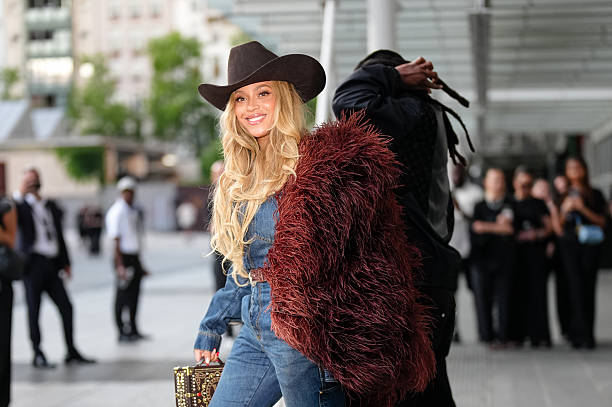
(ThySistas.com) There is a specific hush that falls over music criticism once an artist becomes too important to fail, and Beyoncé crossed into that territory years ago. The proof arrived on the Fourth of July, when she released a track called “Morning Dew (Donk)” as a surprise offering to the faithful. The record is not entirely new. An unreleased song called “Donk” had circulated around Beyoncé lore for years, and a version leaked online in 2023. Now it returns reworked and officially released as part of the countdown toward the twentieth anniversary edition of B’Day. A warmed over cutting room scrap, in plainer terms, dressed as an occasion. Within hours the verdict was in. She still has it, the culture announced, before most of us had heard the thing twice, and the announcement told you everything about the state of the conversation.
Let me be clear about where I stand before going further. My love for this woman’s catalogue runs back most of my life, and what follows comes from devotion rather than spite. That distinction matters more than it once did, because somewhere in the last ten years or so we quietly lost the ability to talk about her as if she makes songs instead of miracles. Play “Morning Dew (Donk)” with clean ears and you hear a pleasant, minor, slightly dated groove that any of a dozen artists could have released to a shrug. Fine, is all. A B side, no more. Yet the apparatus around her cannot process fine, so fine gets translated into triumphant, and an old unreleased song becomes evidence that the reigning queen has never once wavered.
Think about the last time you read a genuinely searching review of her work. Not a rave. Not a takedown either. Something in between, the kind of writing that sits with a record for a week, admires the audacity of the thing while admitting the second half drags, or that one feature never earns its place, or that a concept got announced louder than it got executed. I have to reach back years to find one, and when I do, I remember the pile on that followed. The writer’s mentions turned into a courtroom. Their whole taste went on trial. Every motive got read like tea leaves. And the lesson every music writer absorbed, whether they say it out loud or not, is simple. You praise, or you stay quiet.
The machine that enforces this is famous enough to have a name. The hive shows up fast and it shows up organized, and I want to be careful here because there is a lazy version of this complaint that treats fandom itself as the villain. It isn’t. Passionate listeners are the whole point of making anything. What has changed is the temperature and the reach. A three out of five used to be a defensible opinion. Now it reads to a certain corner of the internet as a moral failing, an insult flung at a Black woman who has already given more than the culture ever thanked her for. And that framing, the one that turns a middling score into an act of disrespect, is where the honesty starts to drain out of the room.
Here is the part that keeps me up, though, the part the cynics skip. That protective instinct did not come from nowhere. Black women in this industry have been robbed in slow motion for a century. Their sounds get borrowed and repackaged and handed to prettier, whiter faces who then get called geniuses for it. The wins arrive delayed, questioned, asterisked. You can watch a woman dominate a decade of popular music, reshape what an album even is, and spend years watching the biggest prize remain out of reach before Cowboy Carter finally broke that pattern. So when her people close ranks, I do not roll my eyes. I get it in my bones. The defensiveness is a scar, and scars form for a reason.
But a scar can grow over a wound that already healed. The tragedy of the current moment is that the shield built to protect her from an industry that undervalued her now protects her from the one thing every serious artist actually needs, which is a listener willing to tell the truth. Somewhere the logic flipped. Loving her stopped meaning engaging with the work and started meaning defending the work, and those are not the same act. A bodyguard and a critic want different things for you. One wants you safe. The other wants you great, and greatness has never come from a room full of yes.
None of this is helped by how thoroughly she has mastered the art of the event. The surprise drop she pioneered, the visual album, the rollout so meticulous it feels less like a release and more like weather moving in, all of it reframes each record as a cultural occasion rather than a collection of songs. And you cannot review an occasion. You can only attend it. When the discourse arrives before the download finishes, when the think pieces about what it means for the country are already queued up, the humble work of listening closely and deciding whether the bridge on track nine lands starts to feel almost rude. Small. Beneath the size of the thing. So critics reach for the language of significance instead, importance, moment, statement, reclamation, and that vocabulary is a beautiful place to hide. It lets you say a lot without ever saying whether the record is any good.
Take her country turn, which I adored and will defend to anyone. That record was a genuine act of reclamation, a Black woman walking back into a genre her ancestors helped invent and got shut out of, and the sight of it moved me. But watch what the conversation became. So much of it centered on the gesture. About Nashville and gatekeeping and history, all of it real and worth arguing over. What received less attention was the actual sequencing, the moments where the album’s ambition outran its focus, the tracks that felt as though they were there to prove a point rather than to be lived with. Those observations existed. They just could not compete with the weight of the story, and so they got whispered, if they got said at all. An artist that big absorbs criticism into her mythology. Every complaint becomes proof of what she is up against. Every doubter becomes a character in her comeback.
And I have not even reached the loneliest corner of this, which belongs to critics who look like her. A Black woman writing honestly about the biggest Black woman alive walks a wire nobody stretched for anyone else. Praise her and you are accused of bias. Question her and you are accused of betrayal, of handing ammunition to people who never wanted her to win in the first place. I have felt the second one personally, the flinch before you type a mild reservation, the internal negotiation about whether the truth is worth the cost to your own standing in your own community. That is not artistic freedom. That is a tax, and it gets levied hardest on the people best positioned to write about her with real understanding.
So can she still be reviewed normally? My honest answer is almost, but not quite, and the gap is widening. The infrastructure that should make honest assessment possible, editors willing to run a lukewarm take, writers willing to sign it, readers willing to sit with disagreement instead of treating it as an attack, has gotten brittle around her specifically. Other enormous artists get the occasional rough review and the world keeps spinning. Around her, the stakes got tangled up in something bigger than the music, in race and legacy and a very justified exhaustion with how this industry treats women who look like us, and once those wires cross, ordinary criticism reads as something it was never meant to be.
She does not want this, for what my reading is worth. The woman is a documented perfectionist. She reportedly reworks, rejects, rebuilds until the thing is right, which means she must know, better than her most devoted defenders, that adoration and improvement live in different houses. You do not sharpen yourself against applause. Somewhere she has to feel the difference between a room that loves her and a room that will tell her the truth, and I suspect the second room has gotten very quiet.
The kindest thing we could do for an artist that magnificent is remember that a mixed review is not a slur. It is a form of respect, maybe the highest one, because it assumes she is an artist and not a monument, capable of a weak song, capable of growing past it, worthy of being met with a whole mind rather than a raised fist. We used to give her that. I would like us to try again. Not because she has fallen off, but because the woman I have followed my whole life deserves listeners, not just guards, and honest music has never had anything to fear from an honest ear.
Staff Writer; Raven Jones
Raven writes about music, relationships, and the everyday ups and downs of Black women… She keeps it honest, encourages other sistas, and can be reached at RavenJ@ThySistas.com.